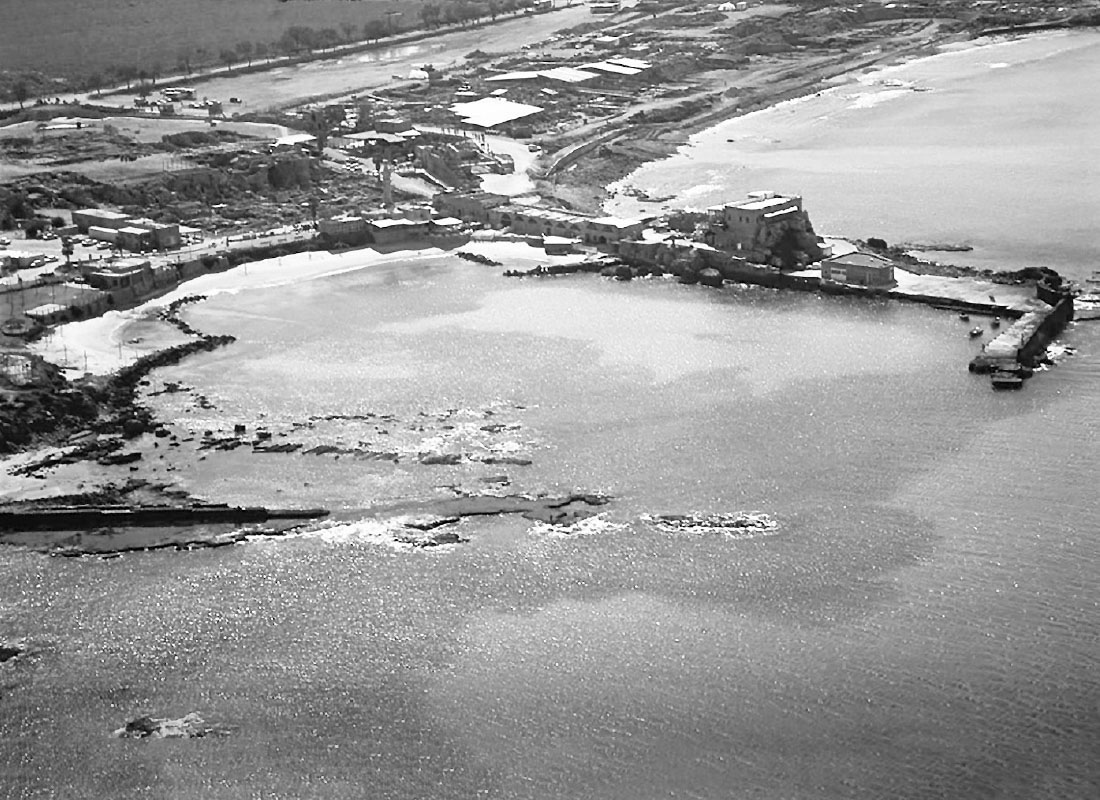
Herod's harbor at Caesarea still sits on the coastline among the remains of his other building projects and some modern buildings.

CAESAREA A Harbor for Sharing God's Word

ACTS 8

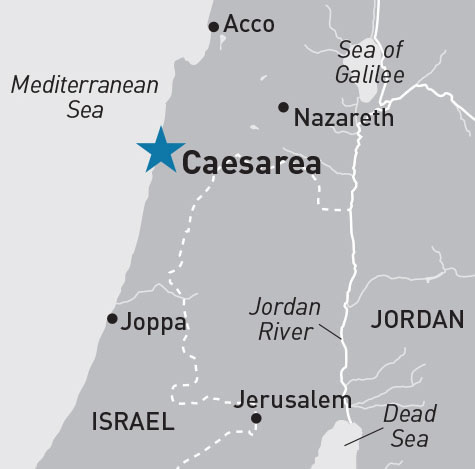
THE STRAIGHT LINE OF ISRAEL'S SEACOAST has never lent itself to significant harbors. For centuries, only Joppa in the south and Acco in the north provided modest havens for ships. But in 22 BC, work began on a new port a vast harbor befitting the grand ideals of its visionary, King Herod the Great. Built on a grand scale, Caesarea's ancient harbor extended out into the sea through an ingenious use of concrete that hardened underwater. In its heyday, the enclosed harbor covered more than forty acres and could accommodate three hundred vessels.

As one of the largest seaports on the eastern Mediterranean coast, Caesarea enjoyed a constant flow of people and commerce. The bustling seaport featured all the usual touches of Roman culture. Caesarea had an immense amphitheater and hippodrome that could accommodate twenty thousand spectators for sporting events and chariot races (think Ben-Hur). A massive theater for thirty-five hundred spectators overlooked the ocean. According to the Jewish historian Josephus, the theater gave stage to the agonizing death of Herod Agrippa I (Antiquities 19.343-352). When Agrippa stood to address the throng that gathered there, the crowd hailed him as a god, and the Lord struck him down because he did not give glory to Him (see Acts 12:20-23). After putting down the first Jewish revolt an levelling Jerusalem's Temple in AD 70, the Roman general Titus celebrated his victory with gladiatorial games in Caesarea.

Caesarea also played a prominent role in early Christian evangelism. Philip the Evangelist settled here (Acts 8:40; Acts 21:8). The apostle Peter travelled here to share the message of Jesus' death and resurrection with a Roman centurion named Cornelius (Acts 10-11). The apostle Paul found himself imprisoned here for two years (Acts 24:27). Finally, it was from Caesarea's port that Paul embarked on his voyage to Rome, where he shared the gospel (see Acts 23:32-26:32).