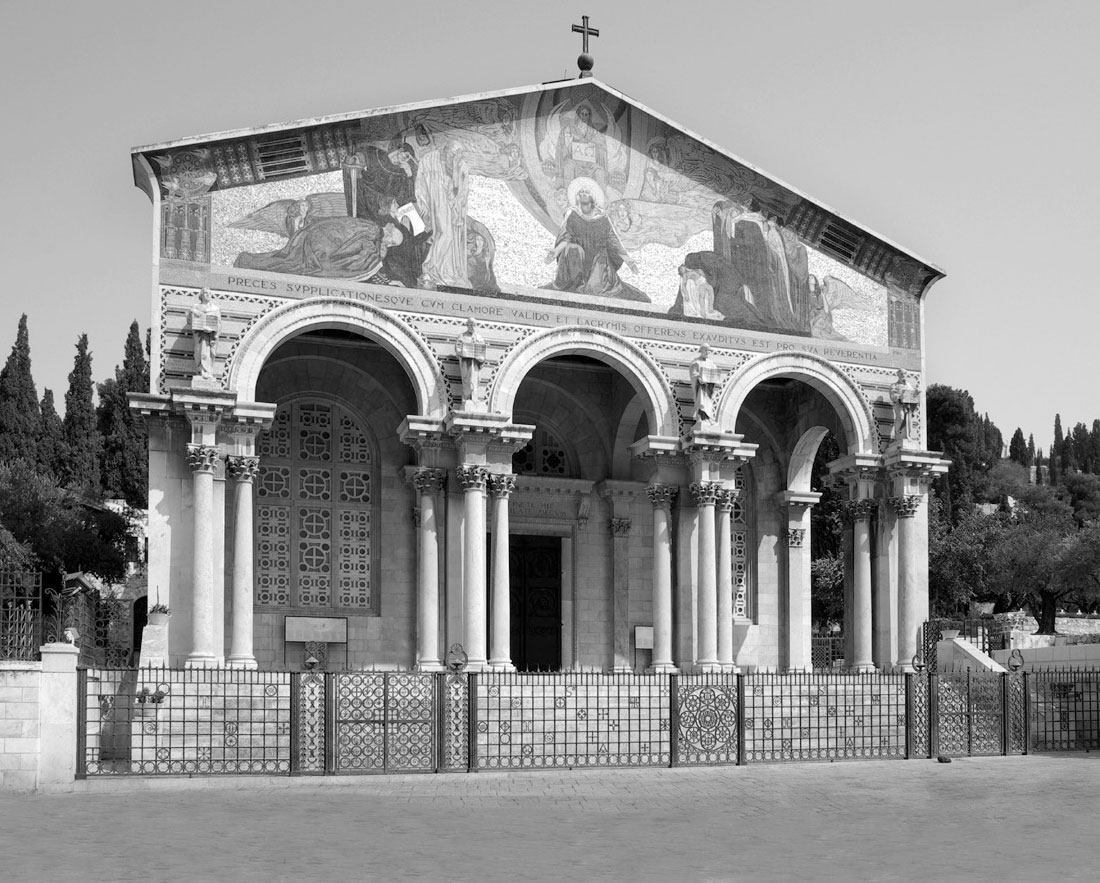
The Church of All Nations is home to a garden with olive trees grown from trees that existed at the time of Christ.

THE GARDEN OF GETHSEMANE A Place of Surrender

MARK 14

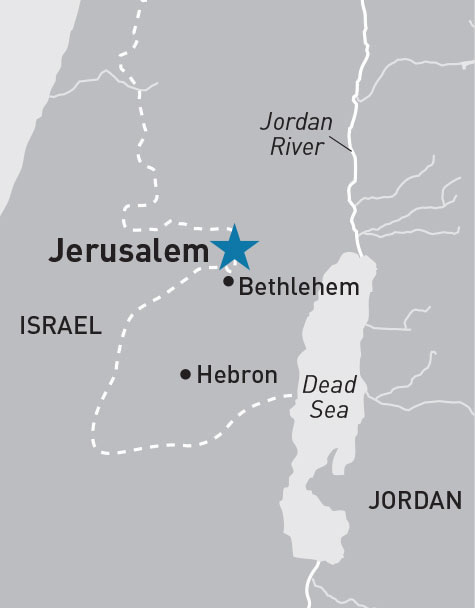
TRADITION POINTS TO A PLACE at the base of the Mount of Olives as the site where Jesus and His disciples often met. The name Gethsemane means "oil press". Archaeologists have uncovered an ancient press inside a small cave beside the garden of Gethsemane. The Byzantines believed this grotto represented the place where Jesus left eight of His disciples while He took three others to pray a short distance away.

Three churches have stood over the site that the earliest Christian community venerated as the garden where Jesus prayed. Between AD 379 and AD 384, the Byzantines constructed what Egeria, a fourth century Christian, would refer to as an "elegant church". The Crusaders rebuilt the church and expanded it around 1170. Today’s Church of All Nations gets its name from the many countries that contributed to its construction between 1919 and 1924. Inside, beautiful paintings and a wrought iron vine of thorns surround a ten square foot mass of limestone, called the Rock of Agony, the spot traditionally believed to be where Jesus prayed on the night before His death.

Beside the Church of All Nations, a dozen olive trees stand in a small garden with colorful blooms planted to accent the trees and gravel pathways surrounding them. An olive tree has no rings, so it's difficult to determine the age of the tree. However, a recent study by the National Research Council of Italy dates the age of several trees there to around nine hundred years old. The roots of these trees go back much further, and they may represent the offshoots of trees that stood in the garden when Jesus prayed there.

Jesus prayed and wept alone in the garden of Gethsemane, choosing to surrender His will to the Father's. His actions model to us that surrendering in absolute trust, as Jesus did in Gethsemane, remains the only path to inner peace.